Record details pane
If you click once on any record in the grid, the details for that record will be displayed in the record details pane on the right of the grid.

If you click once on any record in the grid, the details for that record will be displayed in the record details pane on the right of the grid.
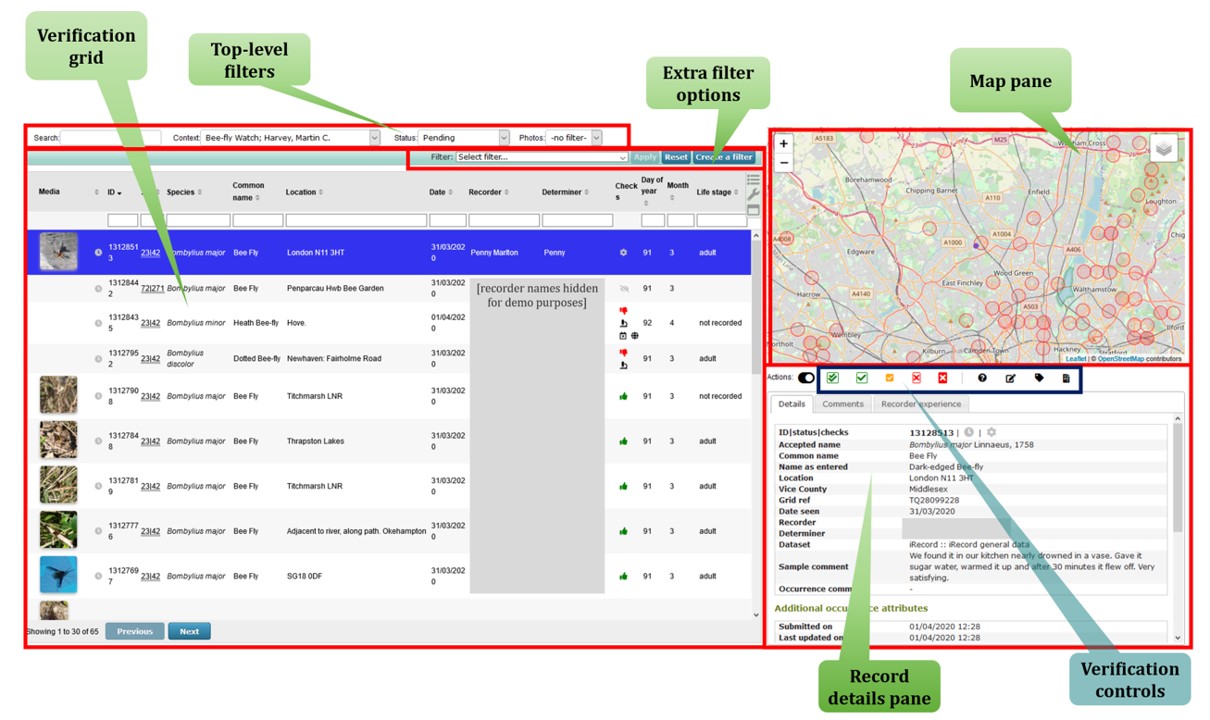
By default the grid displays only those records that have not yet been verified. You can use the filter settings to change this if you want to see the records that have already been verified (see Filtering records in the grid). This page explains the verious elements on the verificaiton grid:
In the main menu bar on iRecord, click on “Verify”. You will see a page that displays the records for verification and provides various tools for carrying this out.
This diagram illustrates the main elements of the verification page:
iRecord provides access to wildlife records submitted by a wide range of people. The records may have been added directly to iRecord, or may come via other websites and apps that share data with iRecord for verification purposes.
Verifiers are asked to assess which records are acceptable for their recording scheme, and give each one an appropriate status, using a set of terms that show whether a record has been accepted or not, and on what basis that decision has been made.
Verifiers on iRecord are set up by agreement with relevant national recording schemes and societies (including county recorders for those schemes/societies), or for particular recording projects. Some recording schemes and societies have an extremely well developed network of verifiers, and produce their own guidance to support the process, whilst others currently have few verifiers and no specific guidance, for a wide range of reasons.
When you import records into iRecord, the records will be allocated to the iRecord account that is signed in at the time of import. In other words, if you log on to iRecord and import some records, those records will be ‘owned’ by your account.
These Help pages are for a new version of the iRecord spreadsheet importer that we made available on 8 August 2024. Please let us know ([email protected]) if you have any corrections to add, or encounter any difficulties.
If you have wildlife records stored in a spreadsheet it is possible to import them into iRecord if you wish to do so, as an alternative to entering them directly onto the iRecord website or app.
This recording form is for entering bird observations, including information on breeding status.
Welcome a summary of data collected by the iRecord Butterflies mobile phone application for 2024. If you have just submitted records, please note that it can take a few minutes for your records to appear on the reports.
*Vice counties are a version of the county boundaries which don't keep changing, so they are very useful for biological records.
Here are a few of the photos recently uploaded from the Butterfly App.
This is a recording form for lists of plant gall records from a single site, date, and recorder. They will feed into the British Plant Gall Society Recording Scheme. Importantly, the form includes bespoke fields for host plant and other associated organisms (e.g. inquilines, parasitoids and predators). Click on the end of a row to expand the associated organism fields.
We are in the process of setting up a network of regional verifiers across Britain; if a verifier is not active in your region then hopefully there will be one in the near future. Your records will help to build up our knowledge about gall-causer distributions, ecology, and conservation imperatives.
For identifying gall-causers, we recommend the excellent illustrated keys in British Plant Galls (3rd edition) by Margaret Redfern, Peter Shirley and Michael Bloxham. Updates to the keys are published periodically by Sam Buckton in the 'Files' section of the British Plant Galls Facebook group, which is also a supportive learning community and a great place to obtain identifications of galls you're unsure about. Updates will also be published on the British Plant Gall Society website in the near future.
See also the in-progress checklist of British gall-causer species, which includes advice about recording grades and information about species' national scarcity and recording/conservation priority status. Further information about galls, including a treasure trove of photos, is available elsewhere on the Society's website.
We recommend subscribing to the British Plant Gall Society in order to receive the Society's journal Cecidology, which is the world's only journal dedicated to plant galls. It features articles at the forefront of the fast-moving world of cecidology in Britain and beyond.